A Troy condo costs about $321,000. A Troy single-family home costs about $450,000. Subtract one from the other and you get a tidy $129,000 discount for anyone willing to trade a yard for a shared roofline. That subtraction is also the wrong math, and the reason why sits three lines down on the listing sheet, in a field most buyers skim past: the HOA fee.
In Troy, that field can mean two almost unrelated things depending on whether the address is a single-family home or a condo, and mixing them up is how buyers end up comparing a $450,000 house that costs $35 a year in association dues to a $321,000 condo that costs $555 a month. That is not a $129,000 gap anymore. It is closer to $6,600 a year in fees before either owner has replaced a furnace.
Two Prices, One Word Doing Too Much Work
The 2026 pricing split reported by Houzeo puts Troy single-family homes at an average of roughly $450,000 against condos averaging roughly $321,000. That gap is real, and it is the number most buyers anchor on when they start comparing a starter condo to a starter house. What it does not capture is that the two products carry entirely different ongoing financial structures, and the word used to describe both of them, HOA, is doing a lot of unearned work.
On a single-family listing in Troy, an HOA is often a neighborhood association: a volunteer board, an annual meeting, maybe a garage sale. On a condo listing, an HOA is a legal entity that owns, insures, and is financially responsible for shared structures. Same three letters. Different obligation entirely.
What "HOA" Means on a Troy Single-Family Listing
The City of Troy maintains a public directory of neighborhood associations, and the dues listed there tell you what a typical single-family HOA actually funds. Sylvan Glen Homeowners Association, covering the area from Long Lake to Square Lake between Rochester Road and Livernois, charges $50 a year. Washington Square Homeowners Association charges $45 annually. Troy Meadows Homeowners Association charges $125 a year and uses part of it to fund an annual garage sale. Oak River East's Phase 1 subdivision association charges $150 a year, its Phase 2 and 3 association charges $225. Beach Forest, on the southwest side of Square Lake and Coolidge, is one of the higher ones at $350 annually.
These are not small monthly payments. They are small annual ones, often covering a shared common area, a newsletter, an Easter egg hunt, or a block party. None of them are sized to fund a roof replacement, because none of them are attached to a shared roof. The house is entirely the owner's structure and the owner's problem.
What "HOA" Means on a Troy Condo Listing
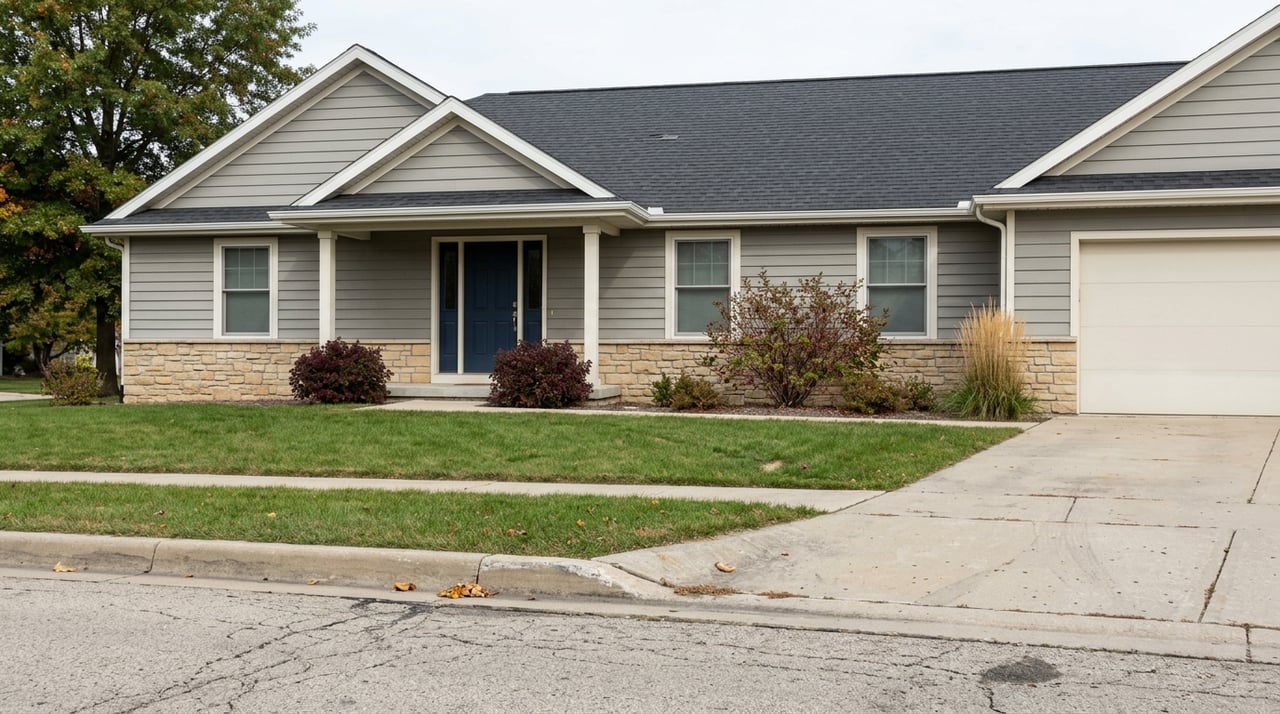
Condo dues in Troy run on a completely different scale and for a completely different reason. Ashton Parc, a 29-unit detached-condo community built by Glen Arbor Building Co. in northern Troy, markets itself as a low-maintenance community with first-floor primary suites. A listing there from last fall carried a monthly HOA fee of $300, and the listing specified exactly what that fee covered: snow removal and landscape maintenance. Nothing else. Depending on how the master deed defines the building envelope, exterior repairs beyond lawn and snow could still land on the owner.
Wexford Parkhomes, an established community of roughly 294 detached condos near Big Beaver Road and John Road in the 48083 zip code, bundles far more into its fee: pool, clubhouse, trash pickup, lawn and snow removal, exterior maintenance, and water. A separate listing in a Troy condo community called Northfield Hills carried a monthly due of $555, at the high end of a range that recent Troy condo listings put roughly between $240 and $401 a month.
Here is the same information laid out side by side:
| Community | Type | Monthly fee (as listed) | What it covers |
|---|---|---|---|
| Ashton Parc | Detached condo, 29 units | ~$300/month | Snow removal, landscape maintenance |
| Wexford Parkhomes | Detached condo, ~294 units | Varies (bundled service) | Pool, clubhouse, trash, lawn/snow, exterior maintenance, water |
| Northfield Hills | Condo | ~$555/month | Full-service (fee at high end of Troy range) |
Three condo communities, three fee levels, three different service packages. That spread is the point. A $300 fee that covers only snow and grass is not automatically cheaper than a $555 fee that covers water, trash, and a clubhouse. It might just be thinner coverage, with the gap showing up later as an out-of-pocket repair bill.
Site Condo vs. Traditional Condo, and Why the Fee Amount Is the Wrong Thing to Compare First
Michigan's own condominium guidance draws a distinction that matters more than any single dollar figure: a site condominium is detached housing organized under condo ownership, where the buyer owns the structure and the lot much like a single-family home, but shares a governing document and some common infrastructure with neighbors. A traditional condo association typically owns and insures the building shell itself, which is why its fee tends to run thicker.
Ashton Parc and Wexford Parkhomes are both marketed as detached condo communities, which puts them closer to the site-condo end of that spectrum. But "detached" does not tell you who owns the roof. That answer lives in the master deed, not the listing description.
The fee amount is not the deal. The exclusion list is.
That is the sentence worth writing on a sticky note before touring a Troy condo. Ask what the fee does not cover before asking what it costs.
The Question a Reserve Study Answers That the Listing Never Will
A statewide look at HOA data found Michigan's typical association fee running near $125 a month, well below what several Troy condo communities are currently charging. That gap is not necessarily a red flag. Communities with pools, water service, or full exterior maintenance built into the fee are supposed to cost more than a bare-bones snow-and-lawn arrangement.
The real risk sits on the other side of that logic. Industry guidance on reserve funding recommends a reserve study cover somewhere between 70 and 100 percent of a community's projected 30-year capital needs. When an association falls short of that, the shortfall does not disappear. It shows up later as a special assessment, and those can run past $10,000 per unit when a roof, siding, or major system finally fails on a building the association was supposed to be saving for. A 2026 property management industry analysis also found that most community associations nationally had faced unexpected expense increases tied to inflation and rising insurance costs, with a majority of boards planning fee increases in response.
None of that shows up on a listing sheet. It shows up in the reserve study, the master deed, and the association's recent meeting minutes, which is exactly why asking to see them before writing an offer matters more in a Troy condo purchase than in almost any other part of the transaction.
Running the Real Math Before You Compare Two Listings
Before treating that $129,000 average gap as your actual savings, run the comparison the way a lender would, not the way a listing price does. That means adding the mortgage payment, the property tax estimate, and the full monthly HOA fee for the condo, then comparing that total to the mortgage and tax payment on the house, where the neighborhood association cost is usually small enough to round to zero.
Before you tour, it helps to ask for:
- The master deed or declaration, so you know exactly what the association is and is not responsible for
- The most recent reserve study, and how close it sits to that 70 to 100 percent funding benchmark
- Any pending or recently completed special assessments
- Whether the fee includes water, trash, or exterior structural maintenance, or only lawn and snow
- How the fee has changed over the past three to five years, not just what it is today
Because Joan King works as both a licensed Realtor and a licensed mortgage originator, this is exactly the kind of comparison she builds into a buyer's numbers before an offer goes in, running the condo fee, the tax estimate, and the financing side together instead of leaving the buyer to reconcile them after closing. If you're weighing a Troy condo against a Troy single-family home, that full-picture comparison is worth having before you fall for a price gap that a fee schedule is about to erase.
FAQ
Is a higher HOA fee always a worse deal in Troy? Not necessarily. A fee that bundles water, trash, exterior maintenance, and amenities like a pool or clubhouse is doing more work than a lower fee that covers only lawn and snow. Compare what each fee includes before comparing what each fee costs.
Do single-family homes in Troy ever have HOA fees like a condo's? Some do, through neighborhood or subdivision associations, but those tend to run in the tens or low hundreds of dollars per year, not per month, and typically fund shared common areas or neighborhood events rather than a building's structure.
What is the single most important document to request before buying a Troy condo? The reserve study, alongside the master deed. Together they show what the association is financially responsible for and whether it has actually saved enough to cover it.
Ready to see how a Troy condo's real monthly cost stacks up against a single-family home in your price range? Joan Schinderle King can walk through the numbers, financing included, before you make the comparison for yourself.